
Olga’s Folk-Healing World
The Painted BirdThis thread follows how Olga’s folk medicine and supernatural explanations give the boy a precarious place in village life before the plague and separation expose the limits of her protection.
increasing Bearing strength in each event
 decreasing
Bearing strength in each eventdecreasingA Purchased Apprentice
A Purchased Apprentice
Entry into Olga’s hut
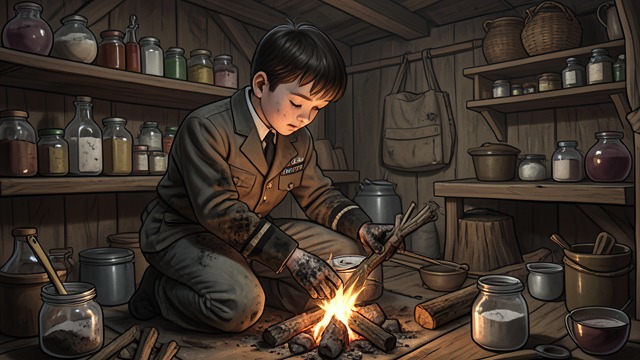
After villagers abuse and display The boy, Olga the Wise One examines him as though he were a patient and bargains with his captor. The exchange places him in her care, but the terms are practical rather than familial: he becomes a helper in a hut crowded with medicinal ingredients and animals.
The boy tends the fire, gathers wood, cleans the stalls, and assists while Olga prepares powders. His usefulness grants him a role and some protection in a hostile settlement, even as his status remains that of a child acquired by an adult.
Learning her practice
Olga’s treatments combine observation, ritual, and brutal remedies. The boy watches her attend patients, including a child whose gangrenous leg she burns and dresses with a mixture of bread, mold, and cobwebs. The work teaches him that care in this world can be inseparable from pain.
He gradually understands Olga’s dialect and accepts instruction through repeated work and shared winter evenings. Her authority depends on the villagers’ belief in her cures, making his presence beside her a temporary shield against the suspicion directed at his appearance.
The Black One
The Black One
A supernatural identity
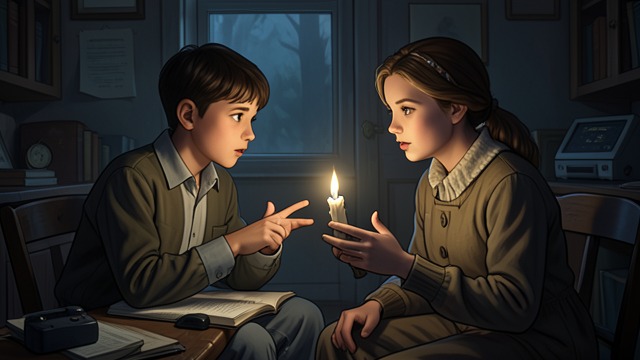
During winter evenings, Olga tells The boy about God, Satan, phantoms, ghosts, and vampires. She calls him the Black One and explains his dark eyes as evidence that an evil spirit lives within him. Her account turns the prejudice he already encounters into an elaborate supernatural identity.
Olga also insists that such eyes can cast or remove spells. The boy is instructed to keep his mind blank when looking at the sick, so that he can help drive disease away rather than harm the healthy. The lesson gives him a task, but makes every glance seem dangerous.
Protection mixed with fear
Olga suspects that The boy may be a vampire and gives him a bitter drink with charcoal to restrain the spirit. Outside the hut, villagers cross themselves, pregnant women flee, and some men set dogs on him. His safety therefore depends less on being accepted than on staying close to Olga.
Her stories make the boy’s surroundings intelligible in the terms available to him. The same beliefs that offer rules for surviving danger also intensify his sense that he is marked, feared, and vulnerable to forces he cannot see.
Buried Against the Plague
Buried Against the Plague
A cure fails
When warmer weather brings a deadly plague, Olga and The boy go from hut to hut trying to treat the sick. People die in spite of their efforts, and the village’s familiar remedies cannot halt the epidemic. The boy witnesses the suffering of families whose children and parents are dying together.
The failure unsettles the order Olga’s healing practice has seemed to provide. Prayer, smoke, and treatment continue, but the disease remains stronger than the explanations and rituals surrounding it.
A desperate procedure
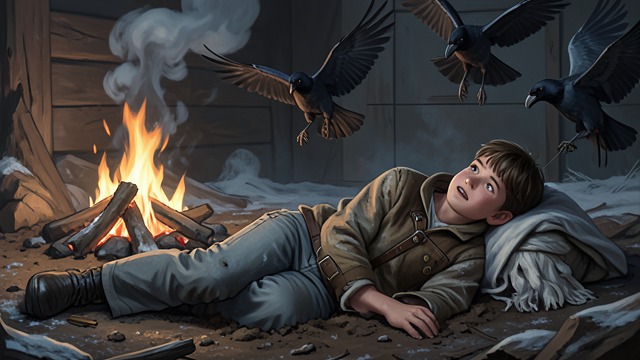
When The boy develops a fever, Olga carries him to a remote field, buries him up to his neck, and builds smoky peat fires nearby. He loses awareness as the cold ground draws heat from his body. In his feverish imagination, he becomes part of the earth and then sees ravens gathering around his exposed head.
The ravens peck at him before he can free himself. Olga eventually finds and digs him out, explaining that the birds took away the sickness after testing whether he belonged among the dead. Her interpretation restores meaning to the ordeal, but the boy’s survival has depended on both her intervention and sheer luck.
The River’s Rejection
The River’s Rejection
A village spectacle
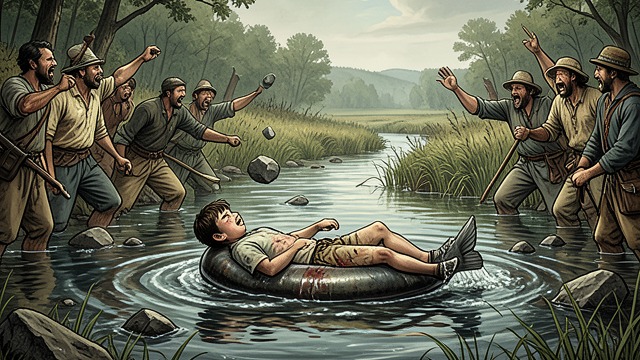
Weeks after the plague subsides, villagers haul a huge catfish from the river. While Olga treats a fisherman’s bleeding arm, the crowd suddenly lifts The boy and flings him onto the fish’s air bladder, which they have thrown into the water. What had been a communal catch becomes a cruel test imposed on a child.
The bladder carries him away as villagers run along the bank, shout, and throw stones. The current pulls him beyond their reach, and the floating object circles helplessly in a whirlpool before drifting toward the marshes.
Separation from Olga
The bladder finally catches on a reed, leaving The boy alone in the marsh. Cold, injured, and afraid, he remembers Olga’s survival lessons: knowledge of plants and animals, and possession of a portable fire. But he has neither her company nor the Comet she had once given him.
Olga’s teaching remains with him even after the village has cast him away. Her belief in magic and her practical advice become part of his private equipment for surviving, though they cannot bring him back to her or guarantee shelter among other people.
Fire Taken from Strangers
Fire Taken from Strangers
A stolen source of warmth
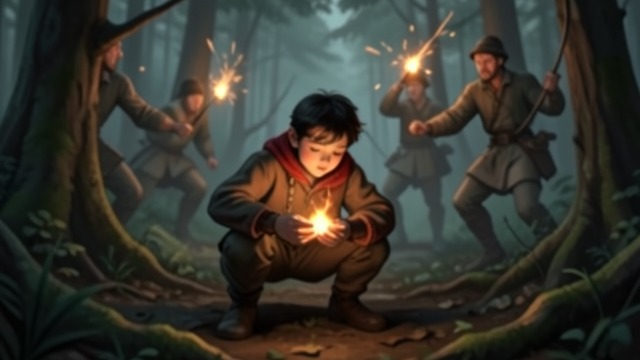
Without the Comet, The boy approaches herdsmen returning from pasture, following the sparks of their portable fires. He uses animal cries and a sudden assault to startle the group, then steals one Comet and retreats into the woods. The act turns Olga’s lesson about fire into a tool he must obtain through violence.
The stolen fire gives him warmth and protection, but the forest remains frightening. Its shapes and sounds awaken the supernatural beings Olga described, so practical survival and imagined danger remain tangled together in his mind.
A lasting influence
The boy believes Olga’s spells will lead him back to her and takes reassurance from her warning that she can bewitch his feet. The narrative does not show a reunion; instead, he moves into another household, carrying her explanations into a life that continues to force him from place to place.
Olga’s influence survives as both knowledge and vulnerability. The Comet helps him negotiate the physical dangers of the landscape, while the stories that once organized those dangers also deepen his expectation of unseen forces and hostile human beings.
After The boy is seized in the first village
During the winter in Olga’s hut
When the plague reaches Olga’s village in spring
After the plague subsides
That night in the marshes after the river escape
